Search This Blog

Monday, January 25, 2010

Colored Pencils

Want a look at how Russian kids learn Russian?

The colored triangles under the letters indicate whether a letter is a hard consonant (blue), soft consonant (green) or vowel (red).

Friday, January 15, 2010

Reading, Reading and More Reading

My resolution for 2010 is to read more, and I don't mean reading more work to translate.

First off is Dina Kaminskaya's Записки советского адвоката (Published in the U.S. as Final Judgment: My Life as a Soviet Defense Attorney, You can get it at abebooks for a couple of bucks). I saw a good review several months ago on openspace.ru and immediately bookmarked it. Her description of growing up under Stalin is riveting, and I really enjoy the details on the day-to-day workings of Soviet courts. I've found that I learn history best by reading memoirs, and Kaminskaya's provides the kind of minutiae that I find fascinating.

Next up: a collection of essays and letters written by Ivan Grozny. I lost this book during a move many years ago and have always missed it. Grozny's proposal of marriage to Elizabeth I of England is priceless.

For the spring: Ilf and Petrov's memoir of their U.S. travels. Hotel Iris by Yoko Ogawa. Any suggestions?

Wednesday, January 13, 2010

Сиринет

A few days ago I ran into a completely unfamiliar word - сиринет (sirinet). From the context it seemed like a musical instrument of some sort. A Yandex search yielded little aside from a mirror of the text I was already translating (love the Russian internet). Google searches for sirinette, syrinette and cyrinette, with or without the additional term "music," were fruitless as well.

When I inquired, the client replied that a сиринет was a phonograph traditionally used to provide music in a pub-style restaurant.

That solved the immediate problem of how to translate the term: in the very non-technical context the word "phonograph" would do nicely. But I am interested in music history, and a music term that comes up with no relevant hits in Google is enough of a mystery to keep me awake at night.

Sleep works wonders.

The next day it dawned on me that the сирин- part of the word could be a phonetic spelling in Cyrillic of a word that used different vowels in its original language. I might be looking at a word that had a connection to sirens, either the Greek ones or the emergency ones.

Bullseye! The Pulsometer Sirenette was a ship's fog horn. Here are some pictures of Sirenettes (third row down) - they look a little like the amplification horn on a phonograph, don't they?[03.2010 NOTE: the picture gallery is moving hosts - I will revise the link once it is up again]

If anyone knows how pub phonographs came to be called Sirenettes in Russian (and whether or not the name was ever in widespread use) I'd love to hear about it.

Грызть

Грызть (gryzt) - to chew or gnaw. From here we get the word for rodent, грызун (gryzun).

The other day it occurred to me to wonder whether or not the Russian word had any connection with the English word grist. Remember the old cliché "grist for the mill?" I turned to the OED and found out that grist is the name for grain to be ground at a mill. It can also refer to the act of grinding. The OED also cited an example from the 15th century where grist means to gnash one's teeth in anger.

So the two words don't just sound alike - they're related! Fascinating!

Wednesday, December 16, 2009

Beowulf and Honey

Where do I start?

When I was very tiny, back when I still thought that every language had its own alphabet (how could it be otherwise?), my favorite bedtime story was Beowulf. Sometimes my father read it to me in Old English. Sometimes he read it to me in modern English from the Norton anthology. Sometimes he retold it out of his head using small words and directing my attention back to the original words when there was a link. Beowulf was important.

A few years ago I happened to see Seamus Heaney's translation of Beowulf at Third Place Books and picked it up mainly for the pictures. Once I got into it, I was intrigued by Heaney's description of how he found his register - he brought up in his mind's eye (or ear) the sound of some of his father's relatives and used their voices to achieve what he calls "forthright delivery."

I know that's something I do. I shamelessly use friends and relatives to choose a register for translating dialogue. If I've ever talked to you, consider this fair warning.

In a similar vein, a while back I read an interview with a Russian screenwriter who admitted that he researched the speech patterns for the cops in one of his movies by watching hours and hours of amateur videos posted online by young cops. Hats off to him for that, of course.

But back to Beowulf. The hero's name is a cypher for "bear" (bee+wolf). Interestingly, the Russian word for bear - медведь - is also a cypher: "one who knows where to find honey." Several people have told me that there used to be another word for bear in Russian: бер (ber). For whatever reason, Russians preferred to call the bear by a nickname and the nickname eventually outlived the true name. You can see the older word in the name for a bear's cave: берлога (ber-LO-ga, or "bear-lying place").


Monday, December 14, 2009

Give me some salted cabbage, no sauerkraut!

I bought the December issue of Хлеб*Соль (Bread*Salt) because it advertised an interview with Valery Syutkin, whose music makes me feel happy and nostalgic. What's that tower of veggies on the cover? It's салат оливье (Olivier salad), the eternal "company's coming" dish made of finely diced potatoes, carrots, pickles, hard-boiled egg, green peas and the meat of your choice, all dressed with mayonnaise and lots of fresh herbs. That may not sound fantastic, but I've had iterations that were very tasty. My friend and mentor Alla Kornibad always added diced green apple. My mother-in-law dresses the salad with sour cream instead of the hated mayonnaise, which she claims is an urban abomination particular to Muscovites. All the wonderful advice I've received about rescuing Olivier from its many pitfalls is for naught - I won't be making it for New Year's or any other holiday.
I do, however, want to make квашенная капуста (salted cabbage). It's nothing like the sauerkraut I remember trying sparingly at church suppers and German-themed festivals in Texas. Russian salted cabbage contains nothing but finely sliced white cabbage, julienned carrots and salt (non-iodized). I've even got a special cabbage knife that produces paper-thin strings of cabbage. You put it all together in a big jar or pot, cover it, and poke holes in it every few days until it tastes done. It isn't really done, however, until you dress a bowl of it with unrefined sunflower oil and add fresh cranberries and chopped green onion. Then you're in heaven (if that's your kind of thing). There's a good article in this issue of Bread*Salt about salted cabbage. From it I learned the word крошиво (kroshivo) - salted cabbage made from the tough outer leaves of the head, plus rye flour.

Monday, December 7, 2009

Lentils - чечевица, сочевица, сочево


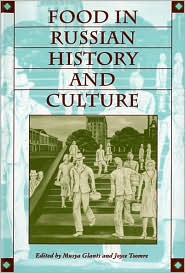
I'm still interested in how the word сочевица morphed into чечевица (lentils). One book I ran across while searching is "Food in Russian History and Culture" - I'll have to pick this one up next time I'm home. I love the cover picture of people carrying boxed cakes. The Google Books preview brought up an interesting passage about disagreement in the Orthodox Church on the proper recipe for kutya.